Monday, March 31, 2008

A Cheap Experiment

I was killing some time this weekend while I was waiting to pick up my son. While he finished his Magic tournament, I was browsing the wine isle of a nearby grocery store. A bottle on the discount table caught my eye. First, the price was only $3.29 and second, one of the grapes in it was one I haven't had before: Müller-Thurgau (# 56 towards my Century count.) I didn't expect much from this purchase but thought it would be a cheap way to start learning about the grape. I'm afraid I'm more confused now!

It appears that Müller-Thurgau is not held in high regard. This grape is a cross of Riesling and Silvaner created by Dr. Hermann Müller in an effort to bring the quality of Riesling to the productivity of Silvaner. I read in several places that the grape is great for growing in colder regions of the world because of it is early ripening and very productive. However, comments like "Müller-Thurgau has never been known for quality and is almost single-handedly responsible for the decline of Germany as a world power in fine wine production" made me wonder about how wine made from this grape would taste.

The wine I bought off the discount table was a Ludwig Neuhaus Piesporter Michelsberg made from 70% Riesling and the remainder from Müller-Thurgau and Silvaner. The first taste was sweet, but it wasn't an overpowering sweetness like I've had with other off-dry Rieslings. The wine had a different flavor, that I can only describe as nut like, though that doesn't quite fit. The wine was more interesting than I expected. The sweetness was balanced by acidity and changed into the "nutty" flavor. The finish, though laking any tannins, left a sour apple flavor. I was surprised at how much I liked the wine.

The sweetness didn't quite allow it to go well with food, but maybe I just didn't have it with the right dish. We had spaghetti noodles with asparagus, zucchini and tomatoes that had been sauteed in garlic and olive oil. By itself, this was a great sipping wine. I think it would be great to serve before dinner.

My lingering confusion comes from enjoying the wine so much but paying so little (I may be falling into the high price = good wine trap.) Also comments like:


"Piesporter Michelsberg is a sub-region of the Mosel surrounding Piesport, not a vineyard. The wines under this declaration mostly come from flat mediocre vineyards at best, and is almost always of very, very, very poor quality."
How to select German fine wine

make me wonder if my palate just isn't experienced enough.

Have you tried a Riesling with Müller-Thurgau that was enjoyable? Especially let me know if you've tried the wines from Ludwig Neuhaus. If I find any bottles of this left when I go back to the grocery store I plan to pick them up. This would make a great wine for the coming hot Sacramento weather.

Related Note:
Last week, Mike Dunne from the Sacramento Bee had an article on Riesling. One of the things he mentioned was an idea to use color coded circles on bottles of Riesling to help consumers know what kind of a Riesling they are buying. Colors "ranging from green for a perceptibly dry Riesling to red for a dessert Riesling, the sweetest of the genre," were suggested. Read the article and let me know what you think.

Tasting Notes:


2005 Ludwig Neuhaus Piesporter Michelsberg Qualitatswein (9% alcohol, $3.29 on sale)

Color:  Light golden yellow

Aroma:  grass

Taste:  light sweetness, nutty flavor; both blend well with the acidity

Finish:  slight sour apple

Friday, March 28, 2008

Carvalho Family Wines

At the beginning of the month I visited several wineries in the Clarksburg area of California. This little know AVA (American Viticultural Area) Is a sixteen mile long by eight miles wide area spanning Sacramento, Solano and Yolo counties. It has over 9,000 acres of vines. Travelling the levee roads along the Sacramento River, you cross many old draw bridges to view the fields of grape vines. Summer days can be very hot in the Sacramento Valley, but the cool Delta breeze keeps the area nine degrees cooler than the city and suburbs of Sacramento.

More than twenty wine grape varietals grow well in the Clarksburg area. The grapes that grow best here are Chenin Blanc and Petite Sirah. Although there are about ten wineries located in the area, 90% of the grapes grown here are crushed outside the appellation. Several wineries are now producing under the AVA name, which may bring recognition for the area. One winery worth getting to know is Carvalho.

Carvalho Family Wines, according to their wed site, has been making wine "over 100 years, starting in the villages and vineyards of Portugal." Their heritage is evident in the port they make using traditional Portuguese varietals of Touriga, Tinta Cao, and Alvarelhao. Other port like wines I tried from other Clarksburg wineries were made from Petite Sirah and Zinfandel. The Carvalho port tasted like the real thing.

The Carvalho family owns the Old Sugar Mill, a former sugar mill converted to a warehouse where they and several other Clarksburg wineries age barrels of wines and have their tasting rooms. It's a convenient way to sample wines from five different wineries in one place. The day I visited I wasn't able to meet the Carvalho wine maker, but the staff that poured for me were very knowledgable and answered all my questions.

One of my goals that day was to sample Clarksburg Chenin Blanc. Just that week, an article came out in my local paper about Darrell Corti being inducted into the Vintners Hall of Fame. In the article, Mike Dunne mentioned Corti's claim that "the best chenin blanc made in California is made in Clarksburg." The Carvalho Chenin Blanc proved Corti's claim.

I have had Chenin Blanc before, but couldn't remember it. All I can remember is descriptions I've read putting it down as a bland jug wine. However, its supposed to have mineral flavors and high acidity that balance well with the sugars when its made off-dry. These sound like the flavors I like about Riesling or a good Sauvignon Blanc. Also, well made Chenin Blanc from the Loire has a distinctive, musty, damp straw aroma. The grape is also grown in South Africa where it is supposed to be made into enjoyable wine. In fact Dr. Debs blog pack on Domaine547 features a South African Chenin Blanc. Winehiker has been saying great things on Twitter about it.

When I tried the Carvalho Chenin Blanc I expected it to be like a sweet Sauvignon blanc but although it smelled of pinapple like a Sauvignon blanc and had some grassy flavors, it was different from the SBs I've had before. I was definitely a light wine, but the flavors were distinct and enjoyable. This was a nice dry wine and possibly because of the 10% Viognier, it had a nice mouthfeel. It had a light finish with an pleasant, almost sour aftertaste. I only bought one bottle (only $9.00) but I may be going back soon for more.

I look forward to trying more Chenin Blanc and other wines from Clarksburg wineries. In fact, on April 20th, Scribner Bend Vineyards is having a "release party" in Clarksburg. They don't have a Chenin Blanc but they make another white wine from the Fiano grape! I'm looking forward to it.

Tasting Notes:

2004 Chenin Blanc, Clarksburg ($9.00, 12.5% alcohol)

Color:  Very faint yellow

Aroma:  Faint nose, like a Gavi

Taste:  Very grassy, faint fruit and intense flavor, dry and very good.

Finish:  Faint tannins and light aftertaste

Thursday, March 27, 2008

The Century Mark

One of my goals in life is to live to be 100 years old. My odds of making it don't look good, as only 1 American in 10,000 has lived to be a century old. I don't think I could ride my bike in a century ride as it takes me almost half an hour to ride 6 miles to work each day. That would translate to about 10 hours of bike riding! There is one century mark that I do have hopes of completing: The Wine Century Club.

Members of this club have tried at least 100 different grape varieties. The group tries to "promote the awareness of uncommon grape varieties" defined as any grape not in the "classic grapes" (Cabernet Sauvignon, Merlot, Pinot Noir, Chardonnay, Sauvignon Blanc and Riesling.) The clickable picture to the left shows the top half of their application, which you can get in either PDF or Excel spreadsheet form. There are about 185 grapes listed on the form, with spaces to add any grapes they may have missed. I'm currently at grape #52, half way towards the century mark.

Seeking to become a member of this group appeals to me for several reasons:

1 - It's a fun way to learn about wine!   After all, what is wine but grape juice. Part of the fun of wine for me is learning what goes into making a wine, where it came from and what grapes it's made from. A wine doesn't have to be a single varietal to count. A Portuguese blend of Touriga, Tinto Cao and Alvarlhao would count as three grapes. (Someone please correct me if I'm wrong on this point!) Having a list and a goal helps give some direction to the general goal of learning about wine.

2 - It appeals to my desire to collect things.   I enjoy learning the history, facts and stories associated with the hobbies I get interested in. I like to have a tangible item that I can look at that reminds me of a particular facet of the hobby. Coin collecting is an obvious example of this, where I tried to find an example of each coin design for a series. In amateur astronomy, I couldn't collect stars, but I would catalog the different celestial objects as I observed them, writing down the date I saw them, a description and sometimes drawing a picture of what I saw. I don't intend to collect bottles of wine, but having the Century Wine Club's list of grapes helps me "collect" the different grapes I've tried.

3 - It is a challenge!   I probably make my life much more complicated than it needs to be. Instead of just riding my bike to work I'll see if I can beat my fastest time. Instead of just taking notes about the wines I drink, I've committed to writing a wine blog. I think one of the reasons I do this though is it makes it more fun. The pursuit of a goal and accomplishing it is a great feeling. I'm going to be trying different wines from different grapes anyway, so why not have something to show for it when I'm done?

I don't want the certificate from the Century Wine Club to my end goal in this pursuit. I want this to merely be a marker on the way to a lifetime of learning about wine and constantly trying new wines. There are almost 200 different grapes on the list. It would be cool to reach my own century mark and have tried 300 different grapes! Gary Vaynerchuk was saying the other day on Wine Library TV that you can't get to know a type of wine until you've had 20 to 40 examples of it. Now that's a goal: 20 different types of each of the 100 grapes! This could get fun.

The Wine Century Club


Here's a list of some of the 391 members current members of the Wine Century Club who have wine blogs:

Wednesday, March 26, 2008

Supporting Local Wineries

Yesterday in her wine blog, Dr. Debs posted a great article titled "Living Not So Big Wine Life." In the post she listed five ways of making our wine purchases and drinking habits less about chasing numbers and pursuing the "best" wine and more about seeking wines that inspire us, that fit our life styles and are "sustainable in all the ways there are," such as the environment, your pocket book and local wineries. (If you haven't seen the post, check it out at Good Wine Under $20.)

I really liked what she had to say but the part about supporting sustainability made me a little nervous. As I understood the point, this meant supporting local wineries especially those that treat the environment respectfully. My fear was that my choices in wines would be limited. I recently went to a Portuguese wine tasting and really enjoyed the red wines made from the same grapes they use to make port. I love the earthy, dried cherry and spice flavors of a Tempranillo from the Rioja in Spain. And I've really been enjoying discovering white wines from Italy with their light but distinct flavors. Would I have to give all this up to support local wineries? It almost seemed a contridiction with another point made about being adventurous.

After calming down...and thinking...I realized that Dr. Debs article was not advocating drinking only what I could find locally. It meant making local more a part of my wine life. It meant not seeking those big, famous wineries that get all the scores to the exclusion of small, local wineries. Besides, there is a lot of variety, and the kinds of wines I've come to like, in my own backyard!

I did a quick search on Google maps to find out how many wineries are local to me. I searched in a 40 mile radius from my house. (If I had expanded the radius to 80 I would have included the Napa Valley wineries, but that would have defeated the purpose of this exercise.) The map to the left shows the partial results of the search, almost 40 wineries. Several of the wineries I have already visited didn't show up in the search and there may be at least a hundred wineries local to me. (Click on the map to see a bigger picture.) I know the message of the article was not to only drink from local wineries, but if I had to, I would still have a lot to choose from!

What's more important than the number of wineries is that these wine makers are growing some of the grapes I've come to love. The Sierra foothills is a great place to grow grapes for Rhone varietals. (Vinography recently said that the Granache from one of my local wineries, Cedarville Wineries, was one the best he tasted at the recent 2008 Rhone Rangers tasting.) Many growers in Lodi, Clarksburg and the Sierra foothills are growing traditionally Italian grapes like Sangiovese and Barbera or even lesser know ones like Primitivo and Vermentino.

You may not be as lucky as I am to live in an area so densly populated by wineries. But seek out local wineries. I was surprised when reading "Wine Across America" how many wineries there are all across the US. I used to envy the French and Italians because it seemed like every community had a winery associated with it. I know that that's not the case, but I'm not very far from having that situation myself! It isn't going to be very hard to support sustainability after all.

Here's an example of how I don't have to do without when drinking locally:

Tasting Notes:

2005 Bray Vinho Tinto: A blend of Portuguese grapes Touriga, Tinto Cao, Souzao and Alvarlhao grown in the Lodi area.

Color:  Deep ruby

Aroma:  Earthy, reminds me of a Rhone

Taste:  Just like a Portuguese red, but with less earthiness. Not a lot of fruit (just a hint of plum), but with a distinct, good flavor. Medium mouthfeel and tannins.

Finish:  Medium finish, tart with nice tannins

<

Tuesday, March 25, 2008

A Negroamora Blend

Last week I had my first Negroamora wine that was made from 100% Negroamora. I enjoyed that bottle and wanted to try another. Last night I tried a wine that was a blend with two other grapes and found that bottle just as good.

Both wines came from the Apulia region of Southern Italy. (For a description of the region, see my post or for a better description, see the WineCountry.IT site.) My second Negroamora was a blend of:

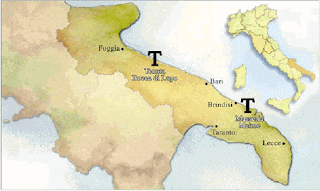
Primitivo is a close relative of Zinfandel and shares some of its characteristics: sweet, soft tannins, almost syrupy fruit and high alcohol. These features blend well with the bitterness and concentation of Negroamaro. When combined with the flavors of Cabernet Sauvignon, the blend gets even better. This wine from Tormaresca Vineyards, owned by the Antinori family’s, was made of grapes that were sourced from two areas of Apulia, Bocca di Lupo and Masseria Maime (see the map, from UST Inc. site.)

This blend was good by itself and with food. When I first smelled the wine the Cabernet really showed up. I smelled cherries and a distinct Cab aroma. When I tasted the wine, I picked up plum and slight cherry. This wine was a little more bitter than the 100% Negroamora I had, but the bitterness didn't overwhelm the wine. The tannins and fruit left a pleasant aftertaste. The wine went well with steak and garlic fries we had for dinner. At $8.99 this was a very affordable and enjoyable red wine that I could enjoy with many meals.

Tasting Notes:


2006 Tomaresca Neprica ($8.99 at BevMo)

Color:  Dark cranberry, with rose on the edges

Aroma:  Cherry, very cab like

Taste:  Plum, slight cherry, slightly bitter, little bit of an alcohol bite

Finish:  Good finish, leaving a plum and tannic taste

Click to Watch WLTV

The latest wine library TV

Changing the wine world.